
Launch
launch in a minute. free.
No launch fee: you pay network fees and the KAS your token’s new cells hold.
 Live on Kaspa mainnet
The launchpad and trading terminal for KCC-20 tokens. Launch a fixed-supply token in about a minute, free, and trade it on a bonding curve from its first block.
The same app in your browser and on your phone: live candles, your own trades marked on the chart, and a receipt for every trade on kascov.
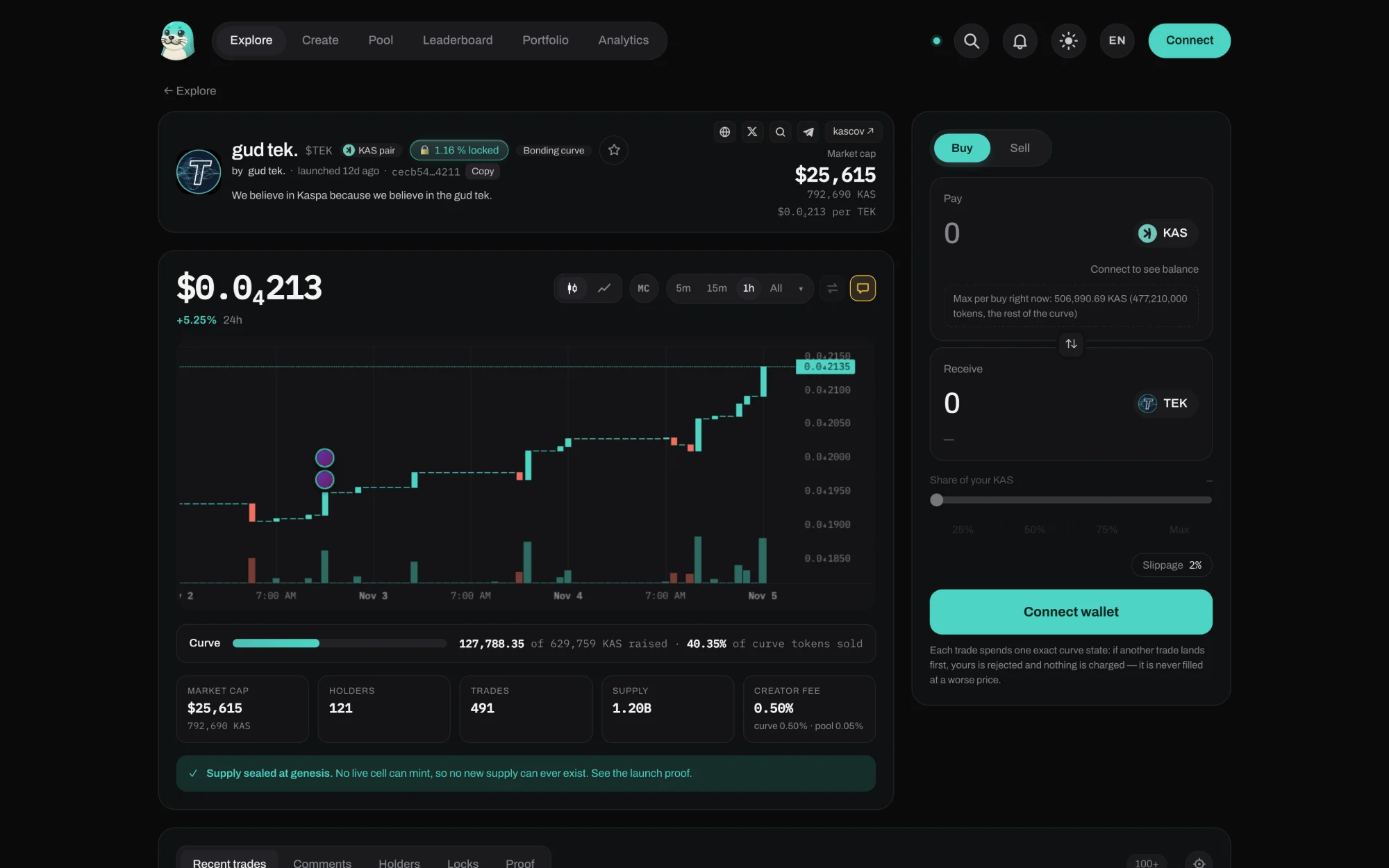
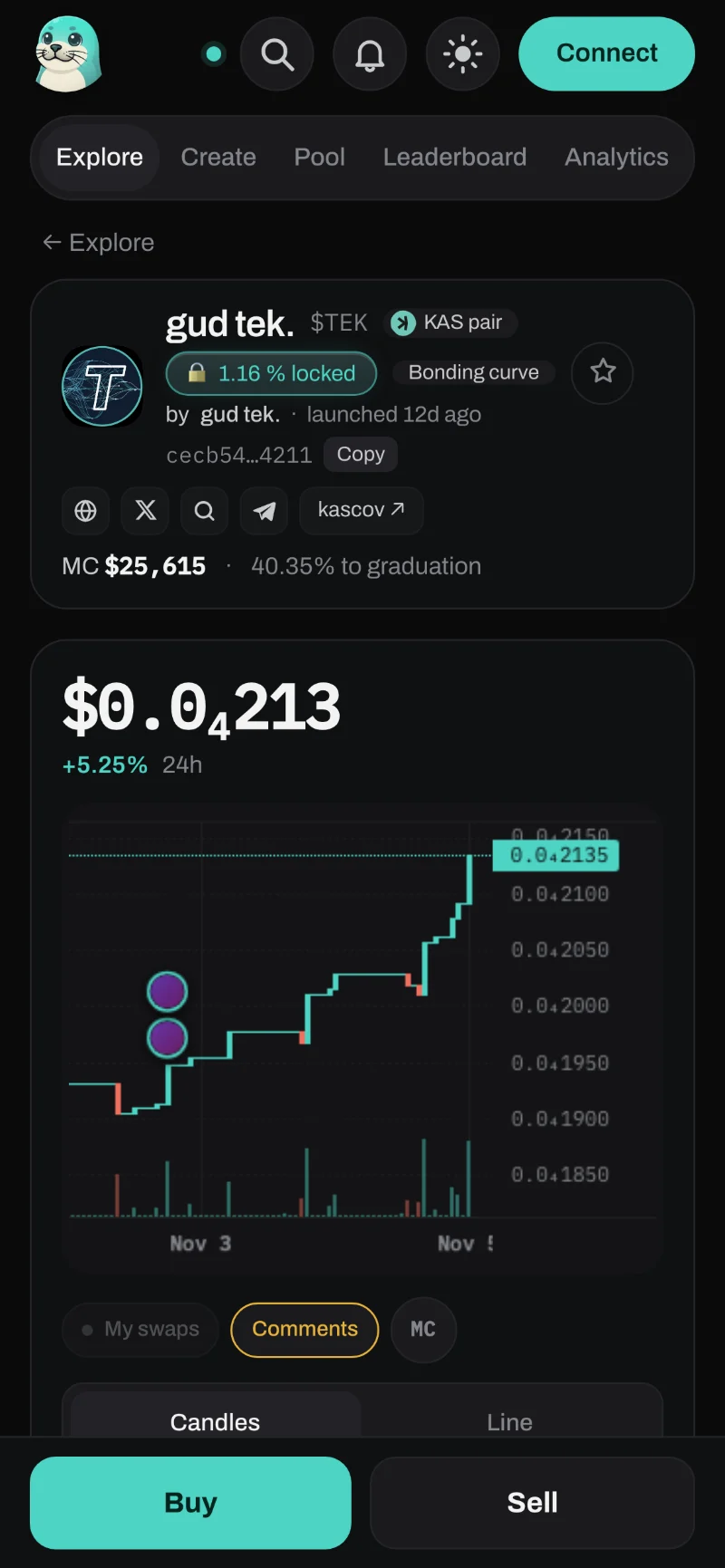
Curves, pools and locks are Kaspa covenants: their rules run on every node, not on a server.
Launch
No launch fee: you pay network fees and the KAS your token’s new cells hold.
Curve → Pool
800M tokens sell on the curve; at sell-out its KAS and 400M reserved tokens open a TOKEN/KAS pool.
Sealed
1.2B tokens are created once, and your browser checks the nine-step launch proof behind every Sealed badge.
Locks
Lock tokens for a beneficiary on a schedule that no one, Kasseal included, can release early.
Wallets
KasWare and Kaspire extensions, or Kaspire Mobile from your phone. Kasseal never holds your keys.

Launch on Kaspa in about a minute, free, or find what’s trading now.
More in the docs.
Kasseal is a launchpad and trading terminal for KCC-20 tokens on Kaspa L1. Anyone can launch a fixed-supply token in about a minute, trade it on a bonding curve from its first block, and trade it on a TOKEN/KAS pool once the curve sells out, with live charts, live trades and your portfolio's PnL in one place. Your own wallet signs every transaction, and Kasseal never holds your KAS, tokens or keys. See What is Kasseal?.
KCC-20 is Kaspa’s covenant-based fungible token standard. A KCC-20 token lives in Kaspa cells whose rules, such as conserving amounts, are checked by consensus on every transaction. Every Kasseal token runs the unmodified reference KCC-20 program. KCC-20 is not KRC-20, which is a different, older token standard on Kaspa. See the Glossary.
Open Create in the Kasseal app, add an image, a name and a ticker (a description and links are optional), and sign in your wallet: a short message proving the funding coins are yours, then two transactions. The first anchors the name and image on chain and creates the curve; the second mints the whole supply and opens trading. See Launch a token.
Kasseal charges no launch fee. You pay the network fees of the two launch transactions and the KAS the token’s new cells must hold: 5 KAS in the curve cell and 10 KAS in each of the two token cells, which stay with the token. The Create screen shows the exact total before you sign. See What a launch costs.
A curve trade pays 1% of its KAS, split 0.50% to the token’s creator and 0.50% to Kasseal. A pool swap pays 0.30% of its KAS side: 0.20% stays in the pool reserves, 0.05% goes to the creator and 0.05% to Kasseal. Launching, graduating and adding or removing liquidity carry no Kasseal fee, and every transaction pays a Kaspa network fee. See Fees.
A token graduates when the last of its 800,000,000 curve tokens is sold. The curve closes, and the KAS it raised plus the 400,000,000 reserved tokens open the token’s TOKEN/KAS pool, with no graduation fee. The Standard curve is sized from the KAS price on launch day to graduate near a $69k market cap; the target is then fixed in KAS. See Graduation.
Sealed means the token’s launch proof passed: its whole supply was created once at launch and no one can mint more. Your browser downloads the launch transactions and runs nine checks itself, trusting only the reference KCC-20 program bundled with the app. Click the badge on any token to open its proof. See The launch proof.
No. All 1,200,000,000 tokens are created in the launch transaction and the token program has no mint function, so the supply can never grow. The liquidity created at graduation has no withdrawal path in any contract, so no one can remove it. See Sealed supply.
A developer buy is the creator’s optional first buy from their own curve, signed as a third signature and sent right behind the launch at the opening price. It can take at most 5% of the supply (60,000,000 tokens) and pays the same 1% curve fee as any buy. For the first 20 seconds after launch only the creator can buy, so the developer buy comes first. See Launch a token.
The KasWare and Kaspire browser extensions connect on Kaspa mainnet, and Kaspire Mobile connects from a phone through WalletConnect. Kastle is listed as coming soon. Your private key and seed phrase never leave your wallet. See Supported wallets.
The wallet that launches a token is written into its contracts as the creator and earns 0.50% of every curve trade and 0.05% of every pool swap. The fees build up inside the curve or pool, and once they reach 10 KAS a claim pays the creator’s share on chain, straight to the creator’s address. Creators see and claim them under Launches on their profile. See Creator rewards.
A token lock holds tokens in a contract on Kaspa and releases them to one beneficiary on the schedule chosen when it was made. Nobody can release them early or shorten the schedule: not the person who locked them, not the beneficiary, not Kasseal. Kasseal charges no fee for locks, and each token page shows how much of its supply is locked. See Token locks.
A covenant is a Kaspa script that controls how a cell can be spent and what the next cell must look like. Kasseal’s bonding curve and pool are covenants, so the price, the fees and the graduation are enforced by every Kaspa node, not by a server. See the Glossary.
Yes. The app builds each transaction and your wallet signs it, so your keys stay in your wallet and Kasseal never holds your funds. Curve and pool funds are held by on-chain covenants that Kasseal cannot withdraw from. Kasseal never asks for your seed phrase. See Your keys stay in your wallet.


trade together.
Claim an @handle, follow the traders you trust and climb the board, in your language.
@Handles
claim your @handle.
Pick a unique username, follow traders and creators, and watch their launches, trades and comments in Following.
Pebble
@pebble
Early on curves. Holding TIDE.
Leaderboard
the board keeps score.
Top traders, top volume, top creators and the most followed, over 24h, 7d, 30d or all time.
Languages
english, español, 中文.
The app speaks English, Spanish, and Simplified and Traditional Chinese.
hello.hola.你好。您好。